
Criminal Cases in the Sumner County Courts
Sumner County divides criminal cases by both charge level and procedural stage. Criminal Court hears every felony and every criminal jury trial. General Sessions decides misdemeanors and conducts the preliminary stage of felony cases. A felony can therefore appear first in General Sessions, then move to Criminal Court after indictment or another valid charging step. Municipal courts handle their own ordinance and citation matters, so a city citation may never be the same file as a county felony prosecution.
The Circuit Court Clerk keeps the digital and paper case record, including dockets, pleadings, orders, evidence, judgments, costs, and sentence material. The sheriff does not become the case-file custodian merely because an arrest or booking occurred at the Sumner County Jail. Likewise, the county's general public-records coordinator does not process court-record requests. Readers tracing an arrest into a filed prosecution should move from the booking source to the clerk's docket, where later charges and outcomes appear.
Sumner County Court Portal
The most important choice in the official Sumner County case search is the court-office combination. Choose Circuit Court with Criminal for felony trial files. Choose General Sessions with Criminal for misdemeanors and felony preliminary proceedings. Selecting only a name without a valid court and case-type pair will not run the intended search.
The portal accepts a party name or reference, case year, and case number. It normalizes capitalization and marks, and longer terms permit limited typo tolerance. Quoted phrases can help with a known name. Results can reach 2,500 rows, sort by column, and use a live Filter box. That result filter is literal, though, so it does not apply the portal's broader phrase and typo rules.
The county search form shown here makes the required court and case-type choices visible before a query is submitted.
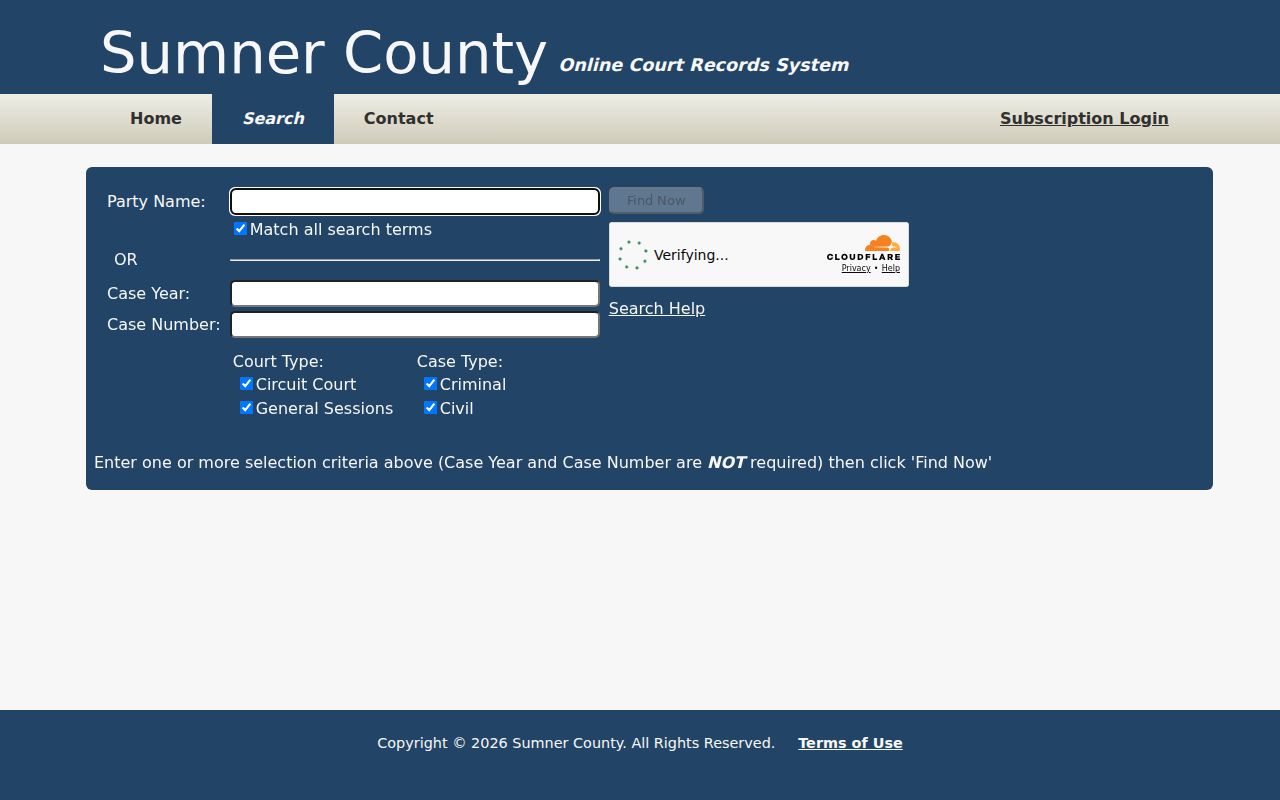
The interface explains why a broad name alone is not enough: a criminal search must also point to the correct Sumner County court office.
How to Search Case Records
Begin with the narrowest reliable identifier. A complete case number is best. A full first and last name plus a likely year is useful when the number is unknown. The clerk should verify any ambiguous match, especially where two people share a name or an online docket lacks the document needed to confirm the outcome.
- Open the official county portal and choose Circuit Court plus Criminal, or General Sessions plus Criminal, based on the case stage.
- Enter the case number when known. Otherwise, use the party name or reference and add the case year to reduce broad results.
- Complete the CAPTCHA and select Find Now. If the search fails, check the court pair before changing the name.
- Sort the results, then use the literal Filter box to narrow the rows already on screen. Read the docket rather than treating a charge label as the outcome.
- Ask the Circuit Court Clerk for documents, evidence, older paper files, or a certified disposition that the public result does not supply.
| Field Label | Type | Required | Notes |
|---|---|---|---|
| Party Name / Reference | Text | No | Full first and last name works best; quoted phrases and limited typo tolerance are supported. |
| Match all search terms | Checkbox | No | Combines terms; the portal may drop final terms when no result appears. |
| Case Year | Number or text | No | Limits the query to a known filing year. |
| Case Number | Text | No | Provides the most direct lookup. |
| Court Type | Checkboxes | Yes | Choose Circuit Court or General Sessions. |
| Case Type | Checkboxes | Yes | Choose Criminal for this record search. |
| CAPTCHA / Find Now | Control | Yes | Enables and submits the search. |
Mobile access works, but the form is easier to review on a larger screen when a broad result set must be sorted. The portal is an index and search route, not a promise that every pleading or judgment can be downloaded at no charge.
Sumner County Criminal Court Levels
General Sessions is not just a traffic counter. It hears Sumner County misdemeanors and the probable-cause phase of felonies. Its published docket themes include probation, private-prosecution, suspended-driving, protection-order, drug, domestic-assault, Tennessee Wildlife Resources Agency, and state-trooper matters on different weekdays. These themes help explain scheduling, but they do not replace a case-specific docket entry.
Criminal Court takes felony litigation and jury trials. The clerk's published rules also address court security, evidence, and access. A municipal citation is different again. Gallatin, Hendersonville, Portland, and Westmoreland each have municipal court contacts, and a city clerk may be the right custodian for its citation record. When the court level is unclear, call the Sumner County clerk and describe the charge, city, and known case number before visiting.
The clerk's Criminal Court page pictured here is the local source for felony jurisdiction and courtroom rules.
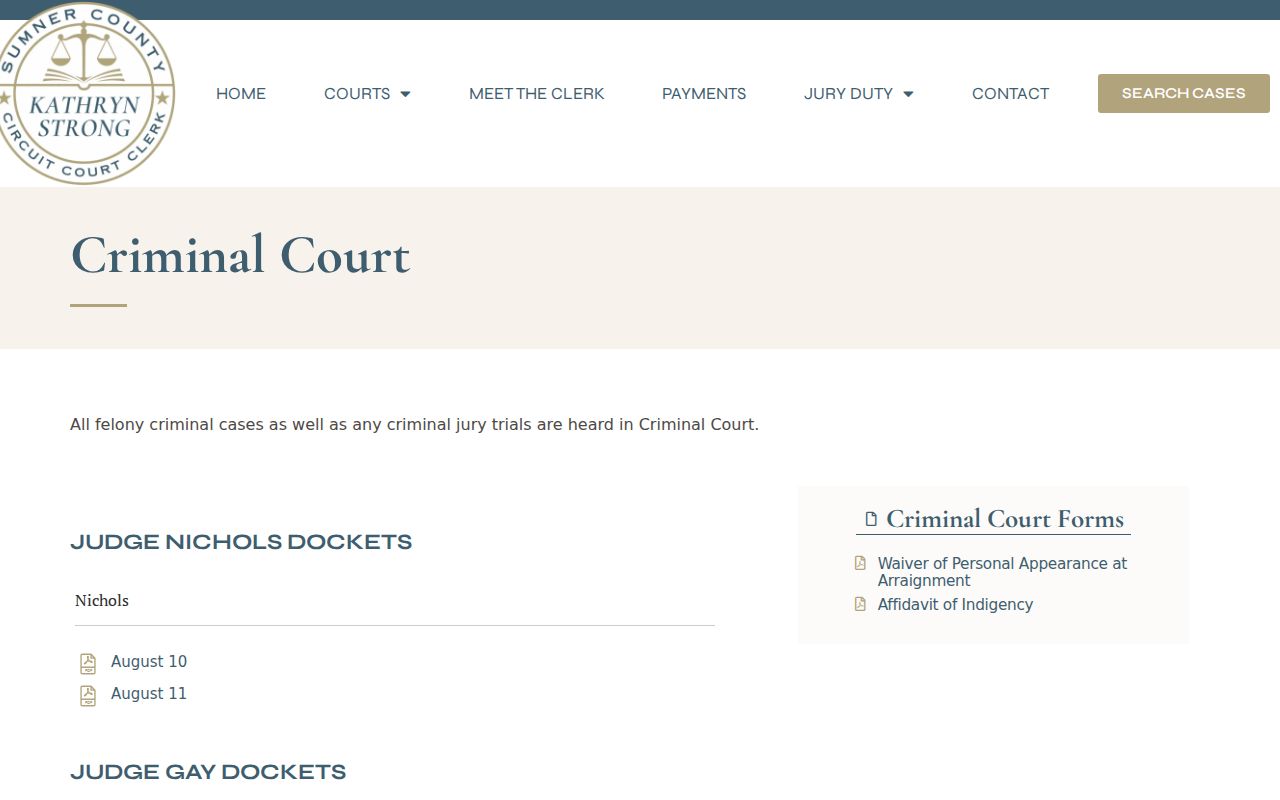
That official page belongs beside the portal because a case result and the rules for obtaining or using the court file answer different questions.
What the Case File Shows
A Sumner County case file records the prosecution as it changes in court. Its charging document frames the filed accusation. Docket entries show what was filed and when. Orders and judgments capture court action. The file may also contain motions, evidence records, financial entries, and sentence terms. It is more complete for the legal outcome than the intake charge shown at booking.
| Case Number and Court | Identifies the specific file and whether it belongs to General Sessions or Circuit/Criminal Court. |
|---|---|
| Charging Document | Shows the complaint, warrant, indictment, or other instrument used to file the accusation. |
| Docket Entries | List filings, settings, motions, orders, and other recorded events in sequence. |
| Hearing Dates | Show scheduled or recorded appearances, subject to later changes in the docket. |
| Disposition and Judgment | State how a charge ended, including dismissal, acquittal, plea, or conviction when entered. |
| Sentence and Conditions | Record the court-imposed result, costs, restitution, custody, or community terms when applicable. |
Ask for a certified disposition or judgment when the exact legal outcome matters. A portal row can guide the request, but certification comes from the clerk who holds the Sumner County criminal case file.
Sumner County Case Outcomes
Docket words can prevent a major reading error. A disposition is the court's outcome for a charge. Nolle prosequi means the prosecutor ended that charge. A no true bill means the grand jury declined an indictment. A retired case is on hold and is not yet a dismissal. An acquittal is a not-guilty result, while a conviction is a guilt adjudication.
- Arraignment
- The stage when the formal charge is presented and a plea is addressed.
- Indictment
- A grand-jury felony charging instrument, often marking the move into Criminal Court.
- Disposition
- The recorded outcome of a charge, not merely its initial filing label.
- Capias
- A custody writ, often issued after a required appearance is missed.
- Retired
- A case placed on hold that has not yet been dismissed.
- Expungement
- Court-ordered removal of a qualifying charge or record under Tennessee law.
Note: Read each charge separately because one Sumner County case can contain different outcomes for different counts.
Stages of a Criminal Case
A Sumner County prosecution begins with a filed accusation, not with a final judgment. General Sessions can resolve a misdemeanor or handle the first felony phase. A supported felony proceeds into Criminal Court, where pretrial motions, a plea, or a trial shape the final result. The clerk then records disposition and sentence and reports the outcome for linking to the Tennessee Bureau of Investigation arrest cycle.
Case flow: Charges Filed › Arraignment › Pretrial › Plea or Trial › Disposition › Sentencing
That reporting link can fail or lag when identifying data is missing. A clerk docket may therefore show a Sumner County disposition before it appears in a TBI history. The certified clerk record is the direct proof of the local case outcome.
Finding Sumner County Court Records
Official Sumner County pages use several addresses for different court functions. Criminal Court is at 117 W. Smith Street. The Criminal Court Clerk's Office is identified at 101 Public Square, while the clerk's main physical address is 155 East Main Street. Rather than guessing which counter holds a file, call 615-452-4367. Choose extension 2 for General Sessions Criminal and traffic, or extension 5 for Circuit and Criminal Court. Published hours are Monday through Friday, 8:00 a.m. to 4:30 p.m.
Sumner County Circuit Court Clerk
155 East Main Street
Gallatin, TN 37066
615-452-4367
Monday-Friday, 8:00 a.m.-4:30 p.m.
Security screening applies. The clerk prohibits phones unless used as evidence, as well as purses, backpacks, bags, recording devices, food, and drinks. Published dress rules also apply. Calling first can avoid arriving at the wrong division or with an item barred from the building.
Access & Restrictions
Tennessee Supreme Court Rule 34 starts from public access to case records but recognizes restrictions created by statute, court rule, or court order. Juvenile records, sealed or expunged matters, victim and minor identifiers, Social Security numbers, account data, medical information, and other protected material may be absent or redacted. Online views may also contain less than the clerk's complete paper file.
The Tennessee Public Records Act does not turn the county's NextRequest coordinator into the court custodian. Court records go to the clerk. A missing portal entry may reflect an older paper file, a sealed matter, an incorrect court pair, or a record that is not linked online. It should not be treated as proof that no case exists. Ask the clerk to search by the known identifiers and explain what form of copy or inspection is available.
Sumner County Appeals Search
The state does not offer a verified unified public search for all Tennessee trial courts. Sumner County trial cases use the local portal and clerk. The Public Case History system serves the Tennessee Supreme Court, Court of Appeals, and Court of Criminal Appeals instead. Use it only after a case reaches that appellate layer.
The appellate search interface pictured here helps mark the boundary between local trial records and state appellate history.
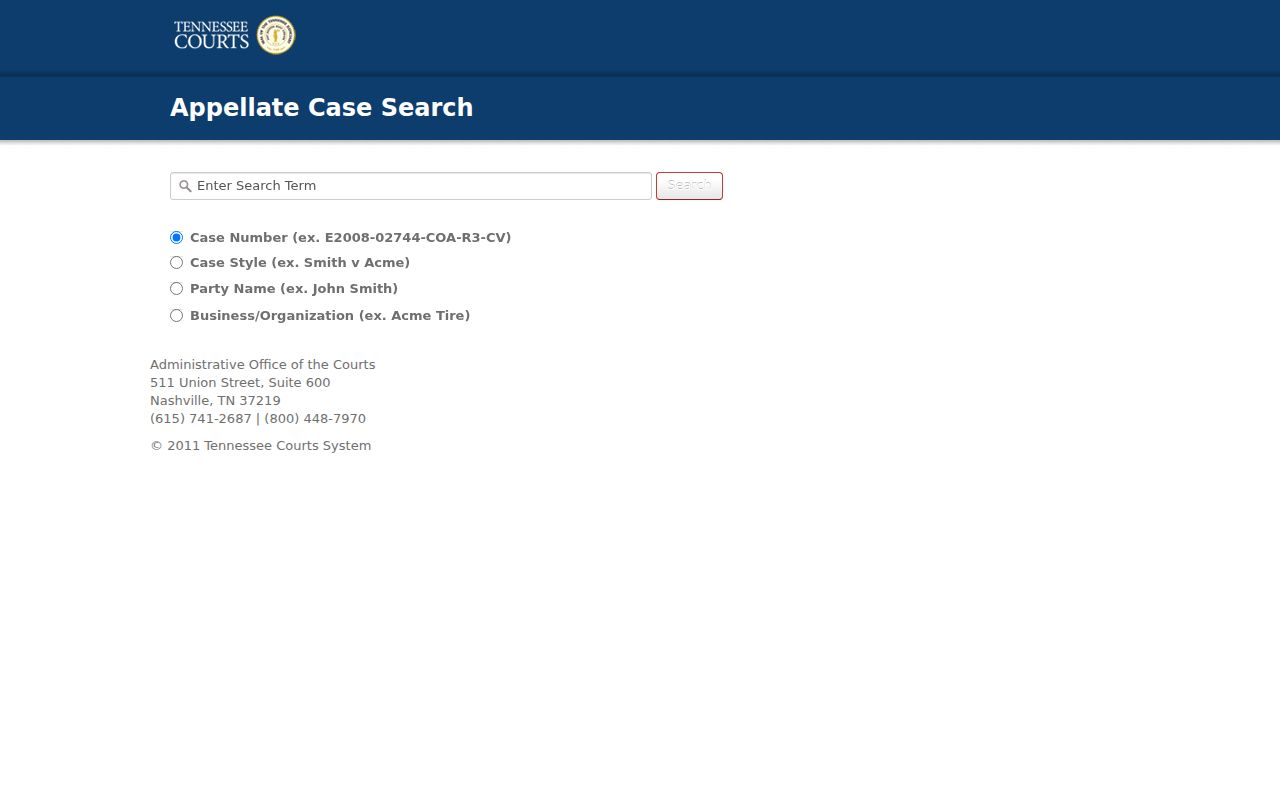
A search there does not replace the Sumner County docket, and no appellate result does not rule out a local criminal case.