
Running a Sex Offender Check in Sumner County
The Tennessee Sex Offender Registry, operated by the Tennessee Bureau of Investigation, is the direct public source for a Sumner County sex offender check. The research found no separate county registry database with broader local data. Start with the state search, select Sumner as the county, and decide whether the incarcerated-person filter belongs in the query. The same portal can accept a partial name, address, city, ZIP code, offender ID, status, or offense. Every field is optional, and up to eight terms can work together.
A result should be treated as a live safety record, not a complete criminal history. Data comes from the registering agency and changes each day. TBI states that it can vouch for accuracy only on the day a record is viewed or printed. Confirm the person through several identifiers, note the listed registering agency, and return to that agency when an address, status, or report date appears wrong. For Tennessee reporting questions, the registry can be reached at 1-888-837-4170 or tbisormgr@tbi.tn.gov.
Sumner County Registry Data Changes Daily
A saved Sumner County registry result can age fast. A person may file an update, move, enter custody, or change reporting status after a PDF is made. The profile's last registration or report date and last information update help place the screen in time. If a report date says "Not Available," that means TBI has not received the directed information. It does not prove that no registration duty exists. This distinction matters when a search is used for a current safety plan.
Use the live record again before relying on an old printout. Compare the displayed address type, status, offense details, and registering agency. A status label such as Active, Absconder, or Inactive-Incarcerated gives context, but the exact options currently shown in the search dropdown were not available during research. Those help terms should not be presented as a fixed menu. For a suspected error, send reasonable proof to the agency shown on the profile rather than reposting the disputed data.
Searching the Tennessee Sex Offender Registry
The Tennessee Sex Offender Registry supports both a focused Sumner County search and a broad identity search. Read and accept the state disclaimer first. Partial names are valid, so an exact spelling is not required. Place terms carefully: adding an address or ZIP can narrow a common name, while removing a term can reveal records that a strict search missed. There is no verified radius control in the researched form, and a ZIP alert should not be described as a radius search.
- Open the TBI registry, accept its terms, and begin with County set to Sumner. Add a partial or full name when one is known.
- Add an address, city, ZIP, status, offense, alias, or offender ID only when it helps distinguish the intended record.
- Choose whether to include prisons and incarcerated people. Leaving that box clear can change the result set.
- Open a result through its photo, then compare status, offense details, report dates, addresses, physical traits, and registering agency before reaching a conclusion.
| Field or control | Type | Required | Use |
|---|---|---|---|
| Search for any offender | Tokenized text | No | Accepts all or part of a name and other supported terms, up to eight |
| Include Prisons/Incarcerated | Checkbox | No | Adds incarcerated or prison registrants |
| Search By Name Only | Mode control | No | Limits how the entered text is read |
| Search By Address Only | Mode control | No | Reads the entered text as an address |
| County | Dropdown | No | Select Sumner for county-focused results |
| Offender Status | Dropdown | No | Current option list was not exposed during research |
| Search / Clear | Buttons | No | Runs the query or removes all criteria |
Sumner County Registry Incarceration Filter
The Include Prisons/Incarcerated box is easy to miss, yet it changes what a Sumner County offender search can show. A person in a correctional setting may not appear in the same result set as someone living at a registered community address. Turn the control on when the purpose is to locate a known profile across custody settings. Leave it off only when that narrower view matches the question.
Do not replace the registry with the Sumner County jail roster or the Tennessee Department of Correction's FOIL system. Those tools answer custody and supervision questions. They do not establish public registry status. Likewise, a registry profile may contain criminal-history entries, but it is not the same as a TORIS background check or a clerk's court file. Each system has a distinct legal role and its own update path.
Note: A missing unfiltered result is not enough to state that a person has no Tennessee registration record.
What a Registry Profile Shows
A full profile supplies far more detail than the result list. Research reviewed the official layout without carrying a private person's identity into the site. The header can show a photograph, displayed name, offender ID, and status. Repeating offense panels provide an offense date, description, Tennessee Code citation, and an expandable legal description or class. Addresses may be marked primary, secondary, or employer and paired with the registering agency. Vehicle groups can show year, color, make, model, body type, tag, and tag state.
The official TBI profile layout illustrates how these fields are grouped.
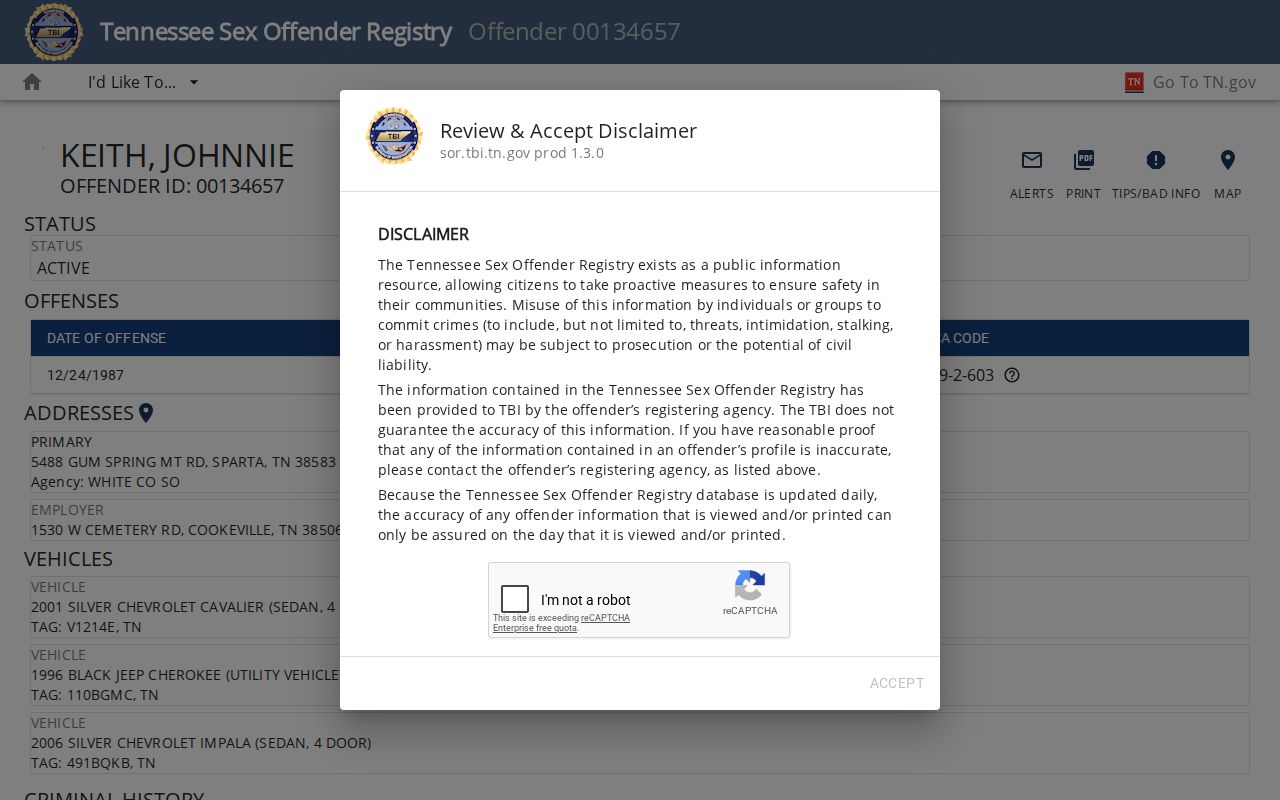
The layout helps a searcher compare identifiers without copying a person's home address or other sensitive profile data elsewhere.
| Identity | Name, offender ID, photo, aliases when present, and physical details such as hair, eyes, race, sex, height, and weight |
|---|---|
| Offense | Date, description, TCA code, and expandable statute information |
| Locations | Primary, secondary, and employer addresses, each tied to an agency when supplied |
| Vehicles | Year, color, make, model, body type, plate, and plate state |
| History and status | Criminal-history date, charge, disposition, current status, and report or update dates |
| Agency | The registering agency to contact about a possible error or compliance concern |
Sumner County Registry Alerts Compared
TBI offers two useful alert paths. One follows a specific offender ID. The other follows a ZIP code. They are not the same tool, and neither should be called a guaranteed distance or proximity alert. A specific-ID subscription is best when a known record is being monitored. A ZIP subscription is broader and tied to the postal area entered. The form first asks for an email address, then lets the user add an offender ID or ZIP to separate tables.
The TBI registry alert screen shows the offender-ID lookup and ZIP entry side by side.
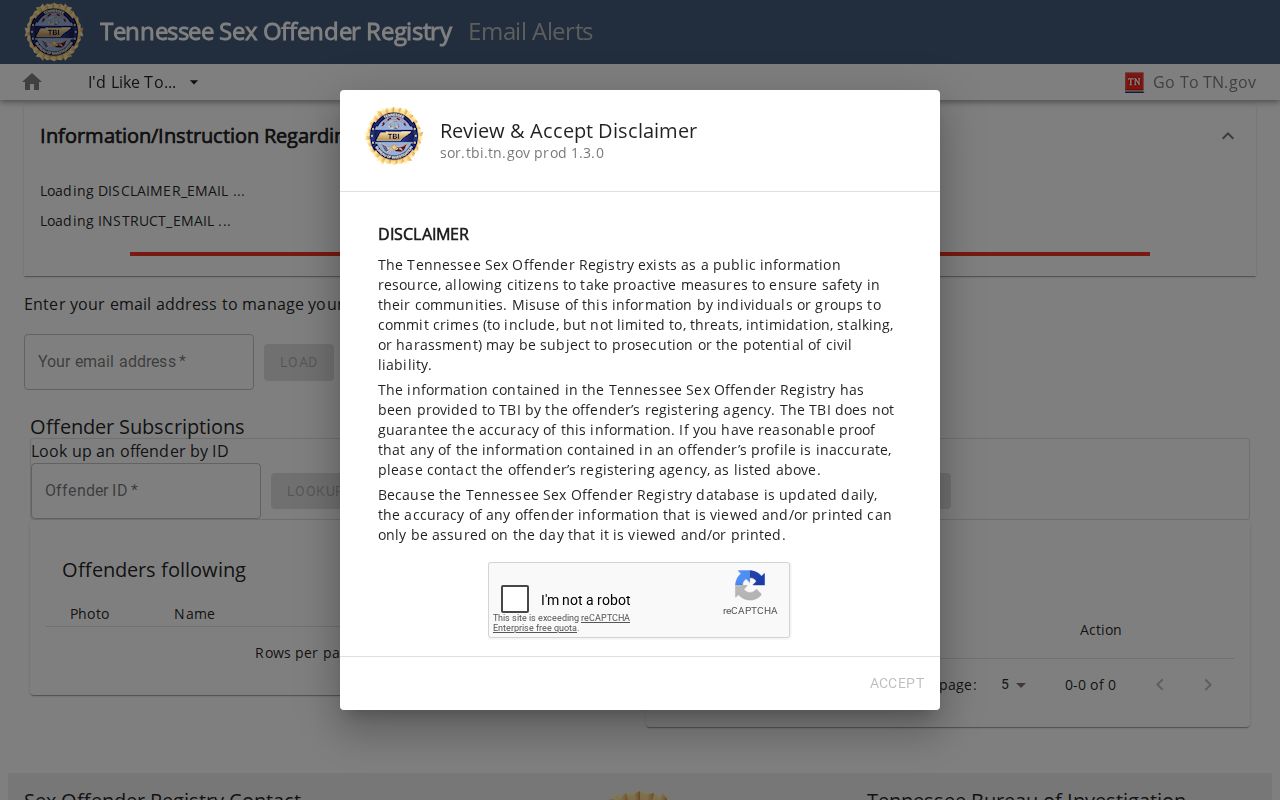
This split makes the alert's scope clear before a Sumner County resident subscribes.
The profile also provides icons for email updates, PDF printing, and sending a tip or update. Save the offender ID rather than relying on a name alone. Names can repeat, while the state identifier points to the intended profile. Even after subscribing, revisit the live registry when a time-sensitive concern arises because alert delivery is not a substitute for current agency confirmation.
Registration Requirements and Levels in Tennessee
Tennessee uses two main public classifications: Sexual Offender and Violent Sexual Offender. It does not use public Tier I, II, and III labels. Duration depends on the classification, victim age, repeat-offense rules, place of conviction, and other statutory facts. A qualifying sexual offender whose victim was at least 13 may request termination ten years after the sentence and active supervision end, if no lifetime trigger applies. The request is not automatic and requires substantial compliance with no new qualifying offense.
| Tennessee category | Public duration or route | Verification |
|---|---|---|
| Sexual offender, victim 13 or older, no lifetime trigger | May request termination after the ten-year post-sentence period and required compliance | Annual |
| Comparable out-of-state sexual offender | Later of ten years after sentence ends or five years on Tennessee registry, with compliance | Annual unless otherwise classified |
| Violent sexual offender | Lifetime; ordinary termination is unavailable | Quarterly |
| Qualifying repeat offender | Lifetime | Based on classification |
| Victim under 13 lifetime circumstance | Lifetime | Based on classification |
Only the registrant or an authorized representative may seek termination and must give TBI the required written proof. A vacated, overturned, or expunged conviction can support removal when no qualifying conviction remains, but the agency still needs the order. Complex cases should be checked against the current TBI registry law and termination information.
Sumner County Registry Distance Rules
Tennessee Code section 40-39-211 generally restricts where covered registrants may live or work in relation to certain sites. The baseline distance is 1,000 feet from the property line of public, private, and parochial schools, licensed child care, public parks, playgrounds, recreation centers, and public athletic fields. The law contains exceptions and fact-specific terms, so a map estimate alone does not establish compliance. Sumner County residents should not measure a point on a consumer map and present that as a legal finding.
Use the registry address for awareness, then send a suspected violation to local law enforcement. Do not approach the listed person. The registering agency can check facts that a public profile cannot show, including a statutory exception or a recent change that has not yet appeared. The related compliance law, section 40-39-208, treats a knowing registration violation as a Class E felony and sets escalating minimum penalties. Those rules govern the registrant; they do not authorize private enforcement.
Sumner County and the National Registry
The TBI registry is the direct source for Tennessee reporting status. When a search involves a move from another state or an uncertain interstate history, add the U.S. Department of Justice's National Sex Offender Public Website. NSOPW collects public search access across participating jurisdictions, but it does not replace the Tennessee profile's state-specific classification, update date, or registering-agency contact. Search both sources when the person or address may cross state lines.
The official NSOPW search is the proper national supplement for a Sumner County registry check.
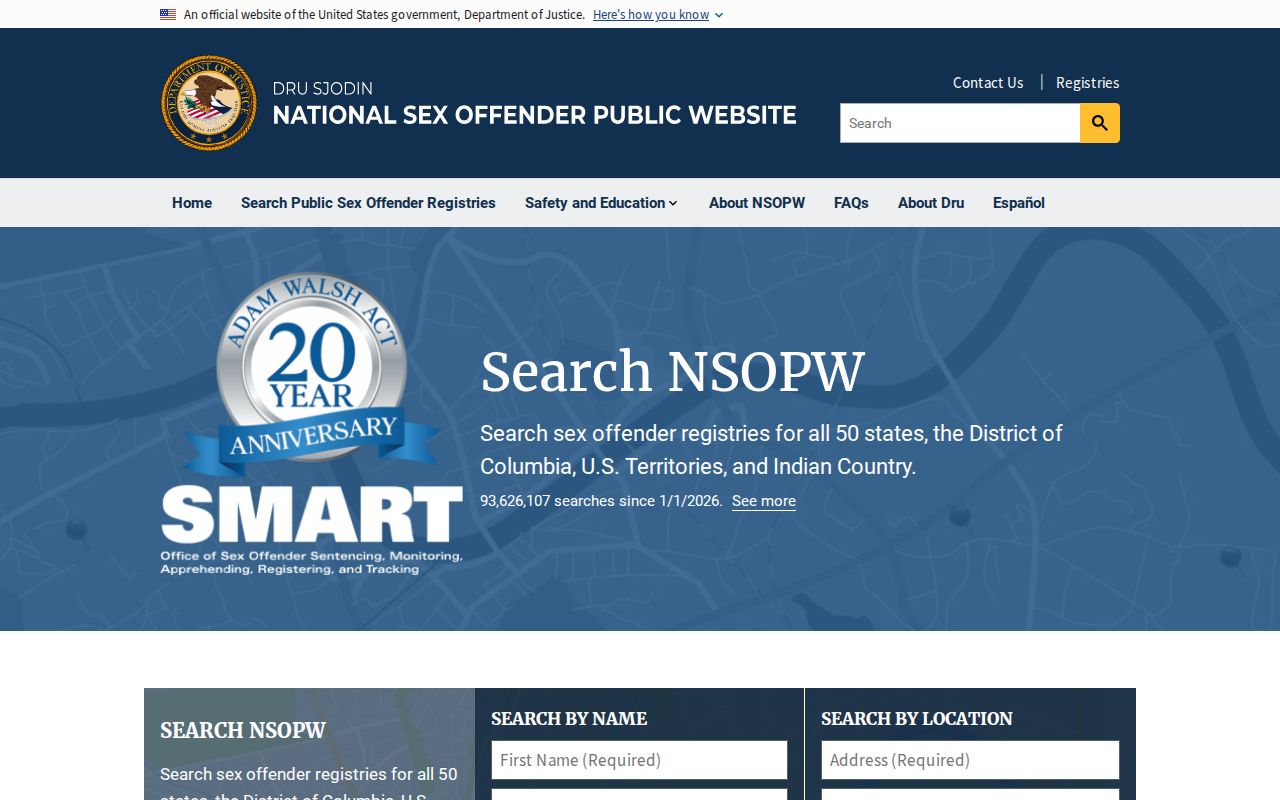
Its national reach fills an interstate gap while Tennessee remains the source for local reporting duties.
A national miss still does not prove that no duty exists. Public access can differ for juvenile matters, and a name variation, incarceration setting, classification rule, or noncompliance can affect a result. Report a well-founded concern to law enforcement. Avoid posting an accusation based on an incomplete query.
Lawful Use and Community Notification
Registry information exists for safety planning and community awareness. Use it to understand a current public record, subscribe to a state alert, or give a specific concern to the agency that can investigate it. TBI identifies threats, intimidation, stalking, and harassment as misuse that may lead to prosecution or civil liability. A registry listing means a person remains subject to registration law. It does not mean the person committed a new offense, and it should not be used as a substitute for a current court file.
If information looks wrong, collect the profile's offender ID, update date, and registering-agency name. Send proof through the profile's tip or update tool or contact the agency. For suspected noncompliance, call local law enforcement or the TBI registry line. That route lets trained staff compare nonpublic information and current reports without inviting confrontation.
Within Sumner County, report an urgent local concern through the Sumner County Sheriff's Office or the police department serving the address. The county jail roster answers a separate custody question, while the Sumner court portal and criminal clerk address filed cases. Neither county system changes the registry status maintained by TBI.
Use the record for safety, not retaliation: Tennessee warns that threats, stalking, intimidation, harassment, and other misuse of registry information may bring criminal prosecution and civil liability.